

SAFARI DRIVE EXPECTATIONS
Top Wildlife Sightings in the Kruger Region
Welcome to our Wildlife Facts page — created especially for our guests!
Please view the list below and select the animal that you would like to read more about:
For assistance, please dial 200
THE BIG 5
LEOPARD

Elusive, powerful, and undeniably captivating, the Leopard is one of Africa’s most iconic and admired big cats. Known for its striking rosette-patterned coat and stealthy nature, this solitary predator is often spotted lounging in trees or silently stalking through the bush. In Kruger National Park, catching a glimpse of a leopard is a treasured moment — a symbol of true safari magic.
Scientific name: Panthera pardus
Family: Felidae (cats)
Lifespan: 10 – 15 years in the wild, up to 23 years in captivity
Weight: 30 – 90 kg (males larger than females)
Conservation status: Vulnerable (IUCN Red List)
Habitat: Highly adaptable, found in savannas, forests, mountains, deserts, and even urban edges.
Range: Widespread across sub-Saharan Africa, parts of the Middle East, Central Asia, India, and China.
Appearance: Golden-yellow coat with distinctive rosette-shaped black spots.
Tail: Long and thick, used for balance — especially when climbing.
Strength: Incredibly strong for its size, they can drag prey heavier than itself up into trees.
Solitary: Leopards are mostly solitary, marking and defending their own territory.
Nocturnal: Primarily active at night (nocturnal), though can be seen during the day.
Stealth hunters: Known for their stealth, patience, and explosive power.
Diet: Opportunistic carnivores, they eat everything from antelopes to birds, fish, monkeys, and even insects.
Ambush predators: Often drag prey into trees to avoid scavengers like hyenas and lions.
Mating: Year-round mating, but peaks may occur in certain regions.
Gestation: Around 90–105 days.
Cubs: Usually 2–3 cubs; they stay hidden in dens for the first few weeks.
Excellent climbers and swimmers.
Known for their ability to adapt to almost any environment.
Their spots help with camouflage, no two leopards have the same pattern.
Unlike cheetahs, leopards can roar.
In folklore and culture, leopards are often symbols of stealth, power, and grace.
LION

Regal, commanding, and deeply symbolic, the Lion is Africa’s most iconic predator and the undisputed king of the wild. With its powerful frame, thunderous roar, and proud mane, the lion captures the imagination like no other. Often found resting in the golden grasslands or moving confidently with its pride, the lion embodies strength, unity, and raw majesty. In Kruger National Park, witnessing a lion in its natural element is a breathtaking experience — a powerful reminder of nature’s grandeur.
Scientific name: Panthera leo
Family: Felidae (big cats)
Lifespan: 10 – 14 years in the wild, up to 25 years in captivity
Weight: Males: 150 – 250 kg | Females: 100 – 180 kg
Conservation status: Vulnerable (IUCN Red List)
Native to: Sub-Saharan Africa and a small population in India (Asiatic lion in Gir Forest).
Habitat: Savannas, grasslands, scrub, and open woodlands, not actual jungles!
Mane: Only males have manes — the thicker and darker the mane, the more dominant and attractive the male.
Roar: Can be heard up to 8 km (5 miles) away — the loudest of any big cat.
Build: Lions are muscular, deep-chested, and have powerful forelimbs for taking down prey.
Carnivorous: Eat large prey like zebra, wildebeest, buffalo, giraffe, and sometimes scavenge.
Team hunters: Females usually hunt together, using strategic group tactics.
Feeding order: Males usually eat first, even if the females made the kill.
Mating: Occurs year-round.
Gestation: About 110 days.
Litter size: Typically 2 – 4 cubs.
Cub mortality: High in the wild, due to predators or takeover by rival males.
Lions sleep or rest up to 20 hours a day, conserving energy for hunting and fighting.
A male lion’s roar and appearance help intimidate rivals and attract mates.
Lions can go 4 – 5 days without water, but will drink daily if available.
Young males are forced out of their pride around age 2 – 3 to find or take over new prides.
Unique among big cats: Lions live in prides, typically made up of females, their cubs, and a few adult males.
Female roles: Hunt together and raise cubs communally.
Male roles: Defend territory and mate with females in the pride.
Pride size: Can range from 3 to 30+ lions.
ELEPHANT
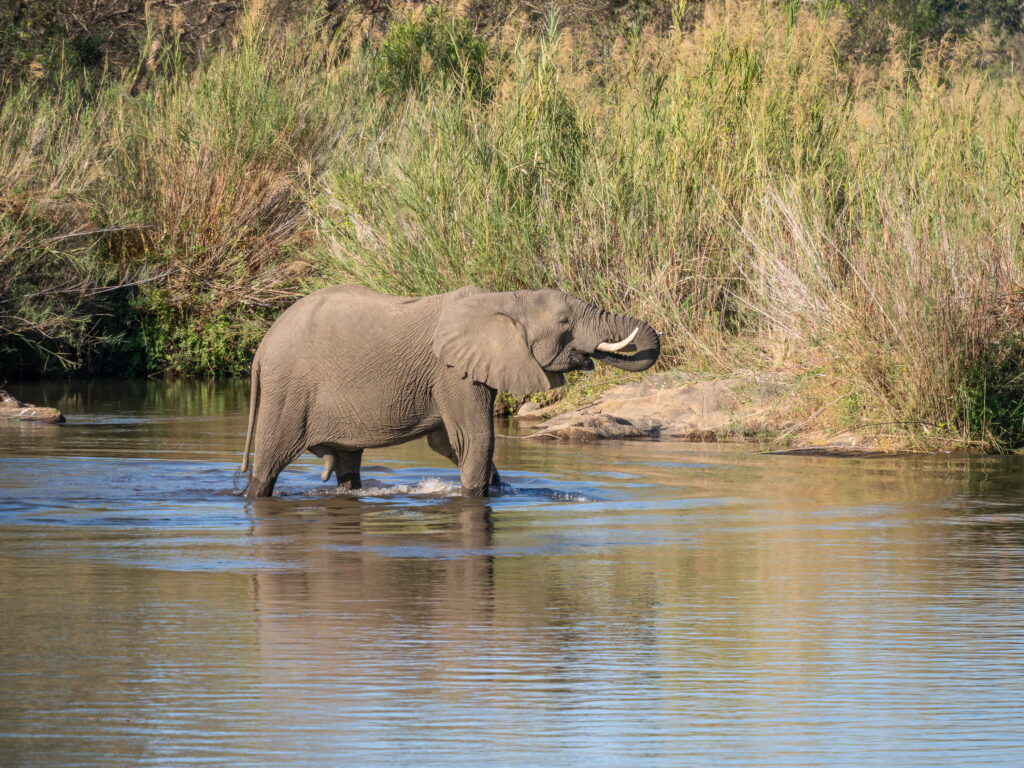
Majestic, wise, and profoundly moving, the Elephant is one of Africa’s most revered and unforgettable creatures. Towering in stature yet gentle in nature, elephants are known for their deep intelligence, close family bonds, and quiet strength. Whether slowly crossing a dusty road or gathering at a waterhole, their presence commands awe and respect. In Kruger National Park, encountering an elephant in the wild is a soul-stirring moment — a humbling reminder of the ancient rhythms and grandeur of the natural world.
Species in Africa:
African savanna elephant: (Loxodonta africana) – the largest
African forest elephant: (Loxodonta cyclotis) – smaller, more elusive
Lifespan: 60 – 70 years in the wild
Weight: Up to 6,000 kg (13,000 lbs) for adult males
Conservation status:
Savanna elephant: Endangered
Forest elephant: Critically Endangered (IUCN Red List)
Found throughout sub-Saharan Africa, in savannas, forests, swamps, and deserts.
Kruger National Park has one of the largest populations of elephants in Africa.
Trunk: A versatile tool with over 40,000 muscles; used for breathing, smelling, touching, grasping, drinking, and communication.
Tusks: Elongated incisor teeth made of ivory, used for digging, stripping bark, and defense.
Ears: Huge ears help with body temperature regulation and display emotion.
Skin: Up to 2.5 cm thick but sensitive, elephants love mud baths to cool off and protect their skin.
Herbivores: Eat up to 150 kg (330 lbs) of vegetation per day; including grass, leaves, bark, roots and fruit.
Spend up to 18 hours a day feeding.
Elephants are highly intelligent and emotionally complex animals.
Known for their memory, empathy, self-awareness, and problem-solving.
Live in matriarchal herds led by the oldest female.
Males typically leave the herd at 12–15 years and live alone or in bachelor groups.
Gestation: The longest of any mammal, 22 months.
Calf size at birth: About 120 kg (265 lbs).
Calves are cared for by the whole herd (a behavior called allomothering).
Communicate using low-frequency rumbles that can travel several kilometers.
Can detect water sources with their feet and trunks.
Elephants mourn their dead, often returning to the bones of deceased relatives.
Despite their size, they can walk silently and are excellent swimmers.
BUFFALO

Strong, steadfast, and unyielding, the African Buffalo is one of Africa’s most formidable and respected wild animals. Known for its massive curved horns, muscular build, and unwavering determination, the buffalo is a true symbol of endurance and unity. Often seen grazing in large herds or standing watchfully in the grasslands, its presence commands caution and respect. In Kruger National Park, encountering a buffalo in the wild is a powerful experience — a reminder of the raw strength and untamed spirit that define Africa’s wilderness.
Scientific name: Syncerus caffer
Also called: Cape buffalo
Lifespan: 15–25 years in the wild
Weight: 400–900 kg (males larger than females)
Conservation status: Least Concern (IUCN Red List), but still vulnerable to habitat loss, hunting, and disease
Found across sub-Saharan Africa.
Prefer savannas, grasslands, swamps, and woodland edges near water sources.
Horns: Large, curved horns that join in the middle to form a “boss” — a thick shield of bone for protection during fights.
Build: Stocky, muscular body built for strength, not speed.
Color: Usually dark brown or black, with older individuals often appearing lighter.
Live in herds ranging from a few dozen to several hundred; in wetter areas, herds can merge into “super herds” of thousands.
Highly social and protective — individuals will defend each other, especially calves.
Males may form bachelor groups or remain solitary when older.
Known for unpredictable temperaments, especially when threatened or injured.
Grazers — feed mainly on grass but will browse leaves during the dry season.
Need to drink water daily, so they stay close to waterholes or rivers.
Breeding season: Can breed year-round, but births often peak in the rainy season when food is abundant.
Gestation period: Around 11 months.
Calves: Usually one calf is born; twins are extremely rare.
Birth weight: Calves weigh about 35–50 kg at birth.
Part of the Big Five because of the challenge and danger they pose to hunters on foot.
Have few natural predators — only lions are a real threat, and even then, it takes teamwork to bring one down.
Known as “the Black Death” in some hunting circles due to their unpredictability.
RHINOCEROS

Powerful, resilient, and steeped in ancient heritage, the Rhino is one of Africa’s most remarkable and endangered creatures. With its thick armour-like skin, striking horn, and formidable presence, the rhino is a true symbol of strength and survival. Whether grazing peacefully on open plains or emerging silently from the bush, its presence commands both admiration and respect. In Kruger National Park, witnessing a rhino in the wild is a rare and unforgettable privilege — a powerful reminder of the need to protect Africa’s most treasured wildlife.
African species:
White rhinoceros (Ceratotherium simum) – largest and more social
Black rhinoceros (Diceros bicornis) – smaller, more solitary, with a hooked upper lip
Lifespan: 35–50 years in the wild
Weight:
White rhino: 1,800–2,500 kg (up to 3,500 kg for large males)
Black rhino: 800–1,400 kg
Conservation status:
White rhino: Near Threatened
Black rhino: Critically Endangered (IUCN Red List)
Found throughout sub-Saharan Africa, in savannas, forests, swamps, and deserts.
Kruger National Park has one of the largest populations of elephants in Africa.
Found mainly in southern and eastern Africa, in savannas, grasslands, and scrublands
Kruger National Park is a key stronghold for both white and black rhinos.
White rhino: Grazers — prefer open grasslands
Black rhino: Browsers — feed on bushes, shrubs, and trees.
Temperament: Black rhinos are more solitary and can be aggressive; white rhinos are more social and calmer.
Daily routine: Spend much of the day feeding and resting in the shade; wallow in mud to cool off and protect skin from parasites.
Gestation: Around 15–16 months — one of the longest among mammals.
Calves: Usually one, weighing about 40–65 kg at birth.
Calves stay with their mothers for up to 3 years.
Rhinos are ancient animals — their ancestors have roamed Earth for over 50 million years
They can run up to 50 km/h (31 mph) despite their size.
A group of rhinos is called a crash.
They play a vital role in shaping their ecosystems by maintaining open grasslands.
Biggest threat: poaching for their horns, driven by the illegal wildlife trade.
Did you encounter any of these big cats on your safari drive?
We’d love to see your wild moments, tag us in your stories and photos on Instagram or Facebook and share the magic of your safari with us!
THE BIG CATS
LEOPARD
Elusive, powerful, and undeniably captivating, the Leopard is one of Africa’s most iconic and admired big cats. Known for its striking rosette-patterned coat and stealthy nature, this solitary predator is often spotted lounging in trees or silently stalking through the bush. In Kruger National Park, catching a glimpse of a leopard is a treasured moment — a symbol of true safari magic.
Scientific name: Panthera pardus
Family: Felidae (cats)
Lifespan: 10 – 15 years in the wild, up to 23 years in captivity
Weight: 30 – 90 kg (males larger than females)
Conservation status: Vulnerable (IUCN Red List)
Habitat: Highly adaptable, found in savannas, forests, mountains, deserts, and even urban edges.
Range: Widespread across sub-Saharan Africa, parts of the Middle East, Central Asia, India, and China.
Appearance: Golden-yellow coat with distinctive rosette-shaped black spots.
Tail: Long and thick, used for balance — especially when climbing.
Strength: Incredibly strong for its size, they can drag prey heavier than itself up into trees.
Solitary: Leopards are mostly solitary, marking and defending their own territory.
Nocturnal: Primarily active at night (nocturnal), though can be seen during the day.
Stealth hunters: Known for their stealth, patience, and explosive power.
Diet: Opportunistic carnivores, they eat everything from antelopes to birds, fish, monkeys, and even insects.
Ambush predators: Often drag prey into trees to avoid scavengers like hyenas and lions.
Mating: Year-round mating, but peaks may occur in certain regions.
Gestation: Around 90–105 days.
Cubs: Usually 2–3 cubs; they stay hidden in dens for the first few weeks.
Excellent climbers and swimmers.
Known for their ability to adapt to almost any environment.
Their spots help with camouflage, no two leopards have the same pattern.
Unlike cheetahs, leopards can roar.
In folklore and culture, leopards are often symbols of stealth, power, and grace.
LION
Regal, commanding, and deeply symbolic, the Lion is Africa’s most iconic predator and the undisputed king of the wild. With its powerful frame, thunderous roar, and proud mane, the lion captures the imagination like no other. Often found resting in the golden grasslands or moving confidently with its pride, the lion embodies strength, unity, and raw majesty. In Kruger National Park, witnessing a lion in its natural element is a breathtaking experience — a powerful reminder of nature’s grandeur.
Scientific name: Panthera leo
Family: Felidae (big cats)
Lifespan: 10 – 14 years in the wild, up to 25 years in captivity
Weight: Males: 150 – 250 kg | Females: 100 – 180 kg
Conservation status: Vulnerable (IUCN Red List)
Native to: Sub-Saharan Africa and a small population in India (Asiatic lion in Gir Forest).
Habitat: Savannas, grasslands, scrub, and open woodlands, not actual jungles!
Mane: Only males have manes — the thicker and darker the mane, the more dominant and attractive the male.
Roar: Can be heard up to 8 km (5 miles) away — the loudest of any big cat.
Build: Lions are muscular, deep-chested, and have powerful forelimbs for taking down prey.
Carnivorous: Eat large prey like zebra, wildebeest, buffalo, giraffe, and sometimes scavenge.
Team hunters: Females usually hunt together, using strategic group tactics.
Feeding order: Males usually eat first, even if the females made the kill.
Mating: Occurs year-round.
Gestation: About 110 days.
Litter size: Typically 2 – 4 cubs.
Cub mortality: High in the wild, due to predators or takeover by rival males.
Lions sleep or rest up to 20 hours a day, conserving energy for hunting and fighting.
A male lion’s roar and appearance help intimidate rivals and attract mates.
Lions can go 4 – 5 days without water, but will drink daily if available.
Young males are forced out of their pride around age 2 – 3 to find or take over new prides.
Unique among big cats: Lions live in prides, typically made up of females, their cubs, and a few adult males.
Female roles: Hunt together and raise cubs communally.
Male roles: Defend territory and mate with females in the pride.
Pride size: Can range from 3 to 30+ lions.
CHEETAH
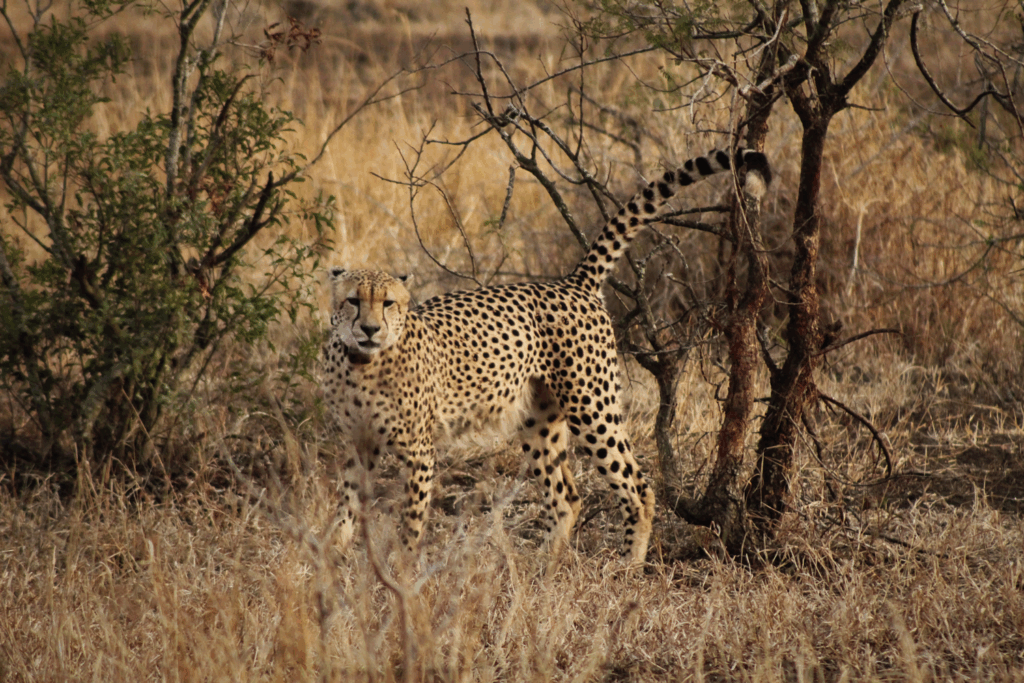
Sleek, swift, and utterly mesmerizing, the Cheetah is one of Africa’s most unique and admired big cats. Famous for its unmatched speed and distinctive black tear markings, this graceful predator is often seen gliding across open plains or scanning the horizon from a termite mound. In Kruger National Park, spotting a cheetah in the wild is a rare and exhilarating experience — a fleeting glimpse of pure safari magic.
Scientific name: Acinonyx jubatus
Family: Felidae (cats)
Conservation status: Vulnerable (IUCN Red List)
Lifespan: 10 – 12 years in the wild, up to 17 years in captivity
Weight: 35 – 65 kg (males slightly larger)
Native to parts of Africa (mainly eastern and southern regions) and a small population in Iran.
Prefers open savannas, grasslands, and semi-arid areas.
Body built for speed: Lightweight frame, long legs, deep chest, flexible spine, and long tail for balance.
Non-retractable claws: Provide better grip during high-speed chases (more like dog claws than other cats).
Black “tear marks” under the eyes help reduce glare from the sun and focus better on prey.
Solitary cats: Females live alone or with cubs; males may form small groups called coalitions (often brothers).
Daytime hunters: Unlike most big cats, cheetahs hunt during the day, mainly early morning or late afternoon.
Diet: Medium-sized prey such as impalas, gazelles, hares, and young wildebeest.
.
Gestation: About 90 – 95 days.
Litter size: 3 – 5 cubs (but mortality rate is high in the wild).
Cubs are born with a silvery mane called a mantle, which helps camouflage them from predators.
Cheetahs cannot roar, but they chirp, purr, growl, hiss, and make unique sounds.
They are the most endangered big cats in Africa, with fewer than 7,000 left in the wild.
Unlike lions and leopards, cheetahs avoid confrontation — they are built for speed, not fighting.
Did you encounter any of these big cats on your safari drive?
We’d love to see your wild moments, tag us in your stories and photos on Instagram or Facebook and share the magic of your safari with us!
DANGEROUS GAME
BUFFALO
Strong, steadfast, and unyielding, the African Buffalo is one of Africa’s most formidable and respected wild animals. Known for its massive curved horns, muscular build, and unwavering determination, the buffalo is a true symbol of endurance and unity. Often seen grazing in large herds or standing watchfully in the grasslands, its presence commands caution and respect. In Kruger National Park, encountering a buffalo in the wild is a powerful experience — a reminder of the raw strength and untamed spirit that define Africa’s wilderness.
Scientific name: Syncerus caffer
Also called: Cape buffalo
Lifespan: 15–25 years in the wild
Weight: 400–900 kg (males larger than females)
Conservation status: Least Concern (IUCN Red List), but still vulnerable to habitat loss, hunting, and disease
Found across sub-Saharan Africa.
Prefer savannas, grasslands, swamps, and woodland edges near water sources.
Horns: Large, curved horns that join in the middle to form a “boss” — a thick shield of bone for protection during fights.
Build: Stocky, muscular body built for strength, not speed.
Color: Usually dark brown or black, with older individuals often appearing lighter.
Live in herds ranging from a few dozen to several hundred; in wetter areas, herds can merge into “super herds” of thousands.
Highly social and protective — individuals will defend each other, especially calves.
Males may form bachelor groups or remain solitary when older.
Known for unpredictable temperaments, especially when threatened or injured.
Grazers — feed mainly on grass but will browse leaves during the dry season.
Need to drink water daily, so they stay close to waterholes or rivers.
Breeding season: Can breed year-round, but births often peak in the rainy season when food is abundant.
Gestation period: Around 11 months.
Calves: Usually one calf is born; twins are extremely rare.
Birth weight: Calves weigh about 35–50 kg at birth.
Part of the Big Five because of the challenge and danger they pose to hunters on foot.
Have few natural predators — only lions are a real threat, and even then, it takes teamwork to bring one down.
Known as “the Black Death” in some hunting circles due to their unpredictability.
CROCODILE

Ancient, powerful, and endlessly fascinating, the Nile Crocodile is one of Africa’s most formidable and enduring predators. With its armored skin, immense strength, and patient hunting instincts, this river giant embodies the primal force of the wild. Often seen basking on sunlit banks or gliding silently through the water, the crocodile rules its domain with stealth and precision. In Kruger National Park, witnessing a crocodile in its natural habitat is a thrilling experience — a striking reminder of the ancient power and untamed essence that flow through Africa’s wilderness.
Scientific name: Crocodylus niloticus
Also called: Nile crocodile
Lifespan: 50–70 years (some live even longer)
Weight: 225–750 kg (males can exceed 1,000 kg)
Length: 3.5–5 meters (11–16 feet)
Conservation status: Least Concern (IUCN Red List), though local populations are affected by habitat loss and hunting
Found throughout sub-Saharan Africa, including rivers, lakes, marshes, and estuaries.
Prefers freshwater environments, but can tolerate brackish water.
Commonly seen basking on riverbanks or lurking just below the surface of the water.
Carnivorous and opportunistic hunters.
Feed on fish, birds, mammals, and occasionally other reptiles.
Known for their ambush hunting style, using stealth and explosive power to capture prey at the water’s edge.
Can survive months without food by slowing their metabolism.
Carnivorous and opportunistic hunters.
Feed on fish, birds, mammals, and occasionally other reptiles.
Known for their ambush hunting style, using stealth and explosive power to capture prey at the water’s edge.
Can survive months without food by slowing their metabolism.
Breeding season: During the dry season.
Females build nests of mud and vegetation near water and lay 25–80 eggs.
Incubation lasts about 80–90 days.
Mothers fiercely guard their nests and assist hatchlings to the water — a rare show of parental care among reptiles.
Nile crocodiles are excellent swimmers, using their powerful tails to glide swiftly through water.
They can hold their breath for over 30 minutes underwater.
Despite their fearsome reputation, they play a vital ecological role in maintaining healthy aquatic ecosystems by controlling prey populations.
Ancient Egyptians revered them as sacred animals, linking them to the god Sobek, symbolizing power and protection.
HIPPOS

Mighty, imposing, and deeply tied to Africa’s rivers, the Hippopotamus is one of the continent’s most extraordinary and formidable creatures. With its massive body, powerful jaws, and commanding presence, the hippo is a true symbol of strength and resilience. By day, they dominate the waterways in large pods, surfacing with grunts and splashes, while at night they emerge silently to graze along the riverbanks. In Kruger National Park, encountering a hippo in the wild is both awe-inspiring and humbling — a vivid reminder of the raw power and untamed spirit that flow through Africa’s wilderness.
Scientific name: Hippopotamus amphibius
Also called: Common hippopotamus
Lifespan: 40–50 years in the wild
Weight: 1,400–4,500 kg (males larger than females)
Conservation status: Vulnerable (IUCN Red List), threatened by habitat loss, hunting for meat and ivory-like teeth, and conflict with human
Found throughout sub-Saharan Africa, primarily in regions with abundant water.
Prefer rivers, lakes, swamps, and floodplains, as they spend most of the day submerged to stay cool and protect their sensitive skin.
Hippos have enormous canines and incisors that can grow up to 50 cm (20 in) long.
Their skin secretes a natural red, oily substance sometimes called “blood sweat,” which acts as sunblock and protects against infections.
Hippos are considered one of Africa’s most dangerous animals due to their unpredictable and territorial nature.
They are most aggressive in the water, where they feel most secure.
Hippos are highly social animals, often living in groups called pods or bloats, usually led by a dominant male.
A pod can range from a few individuals to over 30 hippos.
They are herbivores, feeding mainly on short grass at night.
A hippo can consume around 35–40 kg (80–90 lbs) of grass in one night.
Gestation period: About 8 months.
Usually give birth to one calf, weighing around 25–50 kg (55–110 lbs).
Births often happen in water, and calves can swim almost immediately.
Calves nurse underwater, surfacing to breathe.
Hippos are the third-largest land mammals, after elephants and rhinos.
Despite their size, they can run up to 30 km/h (19 mph) on land.
They spend most of their day in water or mud to stay cool and hydrated.
WILDEBEEST

Restless, buoyant, and deeply connected to Africa’s great plains, the Wildebeest is one of the continent’s most iconic and enduring animals. Recognised for its sturdy build, sweeping horns, and tireless migrations, the wildebeest symbolises movement, survival, and the rhythm of the wild. Often found in vast herds grazing alongside zebras and antelope, it plays a vital role in sustaining the balance of the savanna. In Kruger National Park, watching a wildebeest roam the open grasslands is a captivating reminder of nature’s harmony and the timeless cycles that shape Africa’s wilderness.
Scientific name: Connochaetes taurinus (Blue wildebeest) and Connochaetes gnou (Black wildebeest)
Also called: Gnu
Lifespan: 20 years or more in the wild
Weight: 180–250 kg for males, 150–200 kg for females
Conservation status: Least Concern (IUCN Red List)
Found across southern and eastern Africa.
Prefer open grasslands, savannas, and lightly wooded areas.
Famous for the Great Migration in East Africa, where over 1.5 million wildebeest move between Tanzania’s Serengeti and Kenya’s Maasai Mara.
Appearance: Stocky front body with a sloping back, curved horns in both sexes, and a mane like a horse.
Color: Blue wildebeest have a dark grey or bluish coat; black wildebeest are dark brown to black.
Horns: Up to 83 cm in males, slightly shorter in females.
Highly gregarious, forming large herds often mixed with zebras and antelopes.
Herd structure: Breeding herds (females and young), bachelor herds, and territorial males.
Migrate in search of fresh grazing and water — movements are often triggered by rainfall patterns.
Grazers, feeding primarily on short grasses.
Need daily water, so they stay within reach of waterholes or rivers.
Breeding season: Often synchronised so calves are born at the start of the rainy season.
Gestation: About 8.5 months (260 days).
Births: Calving peaks over a few weeks, creating a “predator swamping” effect that increases calf survival.
Calf development: Calves can stand and run within minutes of birth, following their mothers closely.
Known for their thundering hoofbeats during migrations, which can be heard from far away.
Their migrations are considered one of the Seven Natural Wonders of Africa.
Often targeted by lions, hyenas, and crocodiles — survival depends on speed, herd safety, and vigilance.
Despite their awkward appearance, they can run up to 80 km/h (50 mph).
Did you encounter any of these big cats on your safari drive?
We’d love to see your wild moments, tag us in your stories and photos on Instagram or Facebook and share the magic of your safari with us!
BIG ANTELOPES
ELAND

Graceful, majestic, and quietly powerful, the Eland is Africa’s largest and most elegant antelope. With its spiralled horns, soft tan coat, and distinctive walking click, the eland embodies both strength and serenity. Often seen moving calmly across open plains or browsing peacefully among the trees, it represents the gentle rhythm of the African wilderness. In Kruger National Park, encountering an eland is a moment of quiet wonder — a reminder that true beauty in the wild often lies in its calmest, most unassuming creatures.
Scientific name: Taurotragus oryx (Common Eland)
Also called: Southern Eland or Giant Eland (for Taurotragus derbianus)
Lifespan: 15–20 years in the wild
Weight: 400–1,000 kg (males much larger than females)
Conservation status: Least Concern (IUCN Red List)
Found across southern and eastern Africa, including South Africa, Namibia, Botswana, Zimbabwe, and Kenya.
Prefer open grasslands, savannas, and lightly wooded areas.
Known for being highly adaptable, able to survive in both arid and semi-arid regions.
Both males and females have spiraled horns, though males’ are thicker and shorter.
Males develop a large dewlap under the throat and a distinct clicking sound when they walk — caused by their tendons snapping over their knee joints.
Despite their size, elands are excellent jumpers, capable of leaping up to 2.5 meters (8 feet) from a standing position.
Elands are herbivores, feeding mainly on grasses, leaves, fruits, and seeds.
They are browsers and grazers, depending on the season and vegetation available.
Can survive long periods without drinking water, deriving moisture from their food.
Gestation period: About 9 months.
Usually one calf is born.
Calves can stand and walk within hours of birth and are hidden by the mother for protection during the first few weeks.
Reach sexual maturity around 2–3 years.
Elands are known for their calm and gentle nature compared to other antelope species.
They are social animals, often found in herds of 25–70 individuals.
Historically, elands have appeared in San rock art, symbolizing strength and spiritual significance.
KUDU

Elegant, alert, and effortlessly graceful, the Kudu is one of Africa’s most striking and admired antelopes. With its tall frame, spiral horns, and distinctive white stripes, the kudu perfectly embodies the beauty and poise of the African wilderness. Often seen moving quietly through woodlands or pausing watchfully in the golden light, it carries an air of calm majesty. In Kruger National Park, encountering a kudu is a captivating experience — a glimpse of nature’s artistry and the quiet dignity that defines Africa’s wild heart.
Scientific name: Tragelaphus strepsiceros (Greater Kudu)
Also called: Greater Kudu or simply Kudu
Lifespan: 7–10 years in the wild (can live longer in protected areas)
Weight: 120–315 kg (males much larger than females)
Conservation status: Least Concern (IUCN Red List), though locally threatened by habitat loss and poaching
Found across southern and eastern Africa, including South Africa, Namibia, Botswana, Zimbabwe, Kenya, and Tanzania.
Prefer woodlands, thickets, and savannas — especially near water sources.
Thrive in mixed habitats that offer both cover for protection and open areas for grazing and browsing.
Males (bulls) are known for their magnificent spiral horns, which can twist up to two and a half turns and reach over 1.2 meters (4 feet) in length.
Females (cows) lack horns and are smaller and sleeker in build.
Have a beautiful tawny-grey coat with white vertical stripes for camouflage.
Large, rounded ears give them excellent hearing — crucial for detecting predators.
Herbivorous browsers, feeding mainly on leaves, shoots, fruits, and flowers from trees and shrubs.
Occasionally eat grasses, depending on the season.
Can survive long periods without direct water, drawing moisture from vegetation.
Gestation period: About 8 months.
Usually give birth to one calf, hidden in thick vegetation for the first few weeks.
Calves begin joining their mothers after around 2–3 months.
Sexual maturity is reached at about 2 years for females and 4–5 years for males.
Kudus are among Africa’s most graceful antelope, known for their agility and calm presence.
When alarmed, they emit a sharp bark-like call and bound gracefully through the bush.
Despite their size, they are excellent jumpers, capable of leaping over 2 meters (6.5 feet) high fences or obstacles.
The Greater Kudu is featured on the logo of South African National Parks (SANParks) — symbolizing the country’s natural heritage.
ROAN ANTELOPE
Graceful, alert, and quietly commanding, the Roan Antelope is one of Africa’s most impressive and admired antelopes. Known for its striking reddish-brown coat, elegant backward-curving horns, and powerful build, the roan embodies strength, agility, and resilience. Often seen moving cautiously across open savannas or grazing at the edge of woodland, it exudes both poise and vigilance. In Kruger National Park, encountering a roan antelope is a remarkable experience — a captivating reminder of the elegance and untamed spirit that define Africa’s wilderness.
Scientific name: Hippotragus equinus
Also called: Roan antelope
Lifespan: 12–16 years in the wild
Weight: 230–300 kg (males larger than females)
Conservation status: Least Concern (IUCN Red List), but local populations can be threatened by habitat loss and hunting
Native to sub-Saharan Africa, including countries such as Kenya, Tanzania, Zimbabwe, and South Africa.
Prefer savannas, open woodlands, and grasslands with access to water.
Usually found in areas with tall grasses and scattered trees for cover and shade.
Coloration: Reddish-brown coat with lighter underparts, giving a striking contrast.
Horns: Long, ringed, backward-curving horns present in both males and females, with males’ horns thicker and longer.
Build: Muscular and agile, built for speed and endurance.
Herbivores that primarily graze on grasses, but they also browse leaves, shrubs, and herbs when necessary.
Active mostly during the early morning and late afternoon, resting in the shade during the heat of the day.
Gestation period: About 9 months.
Usually gives birth to one calf.
Calves are hidden in vegetation for protection during the first weeks.
Sexual maturity: Females at 2–3 years, males at 3–4 years.
Roan antelopes are highly social, forming herds typically led by a dominant male.
Known for their alertness and agility, they can quickly escape predators like lions and hyenas.
Considered one of Africa’s largest and most powerful antelopes, closely related to sable antelopes.
Males establish dominance through ritualized horn clashes rather than violent fighting.
SABLE
Elegant, striking, and quietly powerful, the Sable Antelope is one of Africa’s most admired and majestic antelopes. Known for its glossy dark coat, gracefully curved horns, and commanding presence, the sable embodies strength, beauty, and resilience. Often seen grazing in herds or standing alert at the edge of the woodland, it exudes both poise and power. In Kruger National Park, encountering a sable antelope is a memorable moment — a reminder of the elegance and untamed spirit that define Africa’s wilderness.
Scientific name: Hippotragus niger
Also called: Black Sable Antelope
Lifespan: 12–16 years in the wild
Weight: 220–300 kg (males larger than females)
Conservation status: Least Concern (IUCN Red List), though local populations can be threatened by habitat loss and hunting
Native to southern and eastern Africa, including Zambia, Zimbabwe, Angola, Tanzania, and South Africa.
Prefer wooded savannas, grasslands, and areas near water sources.
Often found in areas with dense vegetation for cover and open spaces for grazing.
Coloration: Males are dark black or dark brown; females are reddish-brown.
Horns: Long, curved, and ringed horns present in both sexes, though males’ are thicker and longer.
Build: Muscular with a sleek, powerful frame built for agility and endurance.
Herbivores that primarily graze on grasses, but will also browse leaves and herbs when grass is scarce.
Active mainly in the early morning and late afternoon, avoiding the midday heat.
Gestation period: About 9 months.
Usually gives birth to one calf.
Calves are hidden in vegetation for the first few weeks to avoid predators.
Sexual maturity is reached at around 2–3 years.
Sable antelopes are highly social, forming herds typically led by a dominant male.
Known for their elegant, arched horns and striking coat, they are often considered one of the most photogenic antelopes in Africa.
Males may engage in ritualized horn clashes to assert dominance without causing serious injury.
Part of the “Big 5 of antelopes” due to their beauty, strength, and challenge to hunters.
WATERBUCK
Sturdy, vigilant, and quietly resilient, the Waterbuck is one of Africa’s most distinctive and fascinating antelopes. Known for its robust build, striking white rump ring, and characteristic oily coat that deters predators, the waterbuck embodies strength, survival, and adaptability. Often seen grazing near rivers or standing watchfully at the edge of wetlands, it exudes a calm yet commanding presence. In Kruger National Park, encountering a waterbuck is a remarkable experience, a vivid reminder of the ingenuity and enduring spirit that define Africa’s wild landscapes.
Scientific name: Kobus ellipsiprymnus
Also called: Waterbuck
Lifespan: 12–15 years in the wild
Weight: 200–300 kg (males larger than females)
Conservation status: Least Concern (IUCN Red List)
Found across sub-Saharan Africa, especially near water sources such as rivers, lakes, and wetlands.
Prefer grasslands, floodplains, and wooded savannas with reliable access to water.
Rarely stray far from water, as it is essential for drinking and wallowing.
Males: Dark brown coat with a distinctive white ring around the rump, long spiral horns, and a robust build.
Females: Lighter in color, smaller, and usually hornless.
Adaptations: Greasy secretion from their skin helps repel water and insects.
Herbivores, primarily grazers but will occasionally browse on shrubs and leaves.
Feed mostly on fresh grasses, which are abundant near water.
Gestation period: About 8 months.
Usually give birth to one calf, hidden in tall grass for protection during the first few weeks.
Calves are able to stand and follow their mother within hours.
Sexual maturity: Females at 2–3 years, males at 3–4 years.
Waterbucks are highly territorial, with males marking and defending territories near water.
Known for their loud, nasal call, which can be heard over long distances.
Despite their size, they are excellent swimmers and often escape predators by fleeing into water.
They secrete a special oily substance from their skin when stressed, which gives their meat a strong taste; as a result, many predators tend to avoid hunting them.
Predators include lions, leopards, hyenas, and crocodiles, though the oily secretion provides an additional layer of protection.
Did you encounter any of these big cats on your safari drive?
We’d love to see your wild moments, tag us in your stories and photos on Instagram or Facebook and share the magic of your safari with us!
MEDIUM ANTELOPES
BUSHBUCK
Elusive, graceful, and quietly resilient, the Bushbuck is one of Africa’s most secretive and captivating antelopes. With its sleek, camouflaged coat and elegant spiral horns, the bushbuck blends seamlessly into the dense woodlands and thickets it calls home. Often seen moving cautiously through undergrowth or pausing alertly at the forest edge, it embodies both stealth and subtle beauty. In Kruger National Park, encountering a bushbuck is a rare and memorable experience. A gentle reminder of the hidden wonders and quiet mysteries that thrive within Africa’s wilderness.
Scientific name: Tragelaphus scriptus
Also called: Bushbuck
Lifespan: 10–12 years in the wild
Weight: 30–80 kg (males larger than females)
Conservation status: Least Concern (IUCN Red List)
Found throughout sub-Saharan Africa, from savannas and forests to riparian zones.
Prefer dense bush, forest edges, and thickets for cover and protection.
Highly adaptable, able to survive in both wet and dry regions as long as cover is available.
Males: Usually darker with a sleek coat, possess spiral horns up to 45 cm long.
Females: Hornless and slightly lighter in color.
Coat: Brown with faint white spots or stripes; provides excellent camouflage in dense vegetation.
Herbivorous browsers, feeding mainly on leaves, shoots, fruits, and flowers.
Occasionally graze on grass but rely heavily on shrubs and low trees.
Gestation period: About 6–7 months.
Usually give birth to one calf, hidden in dense vegetation for safety during the first weeks.
Calves begin following the mother and slowly integrate with other bushbucks.
Sexual maturity: Females at 1–2 years, males at 2–3 years.
Bushbucks are solitary and secretive, rarely forming large herds.
They are excellent swimmers, often crossing rivers and wetlands with ease.
Known for their keen senses — sharp eyesight, hearing, and smell help them evade predators.
Predators include lions, leopards, hyenas, and large snakes, but their elusive nature makes them difficult to catch.
IMPALA

Graceful, alert, and endlessly agile, the Impala is one of Africa’s most iconic and admired antelopes. Known for its sleek build, striking markings, and astonishing leaping ability, the impala embodies speed, agility, and vitality. Often seen grazing in large herds or springing effortlessly through the savanna to evade predators, it captures the dynamic energy of the African wilderness. In Kruger National Park, encountering an impala is a lively and memorable experience — a vivid reminder of the beauty, resilience, and constant motion that define Africa’s wild landscapes.
Scientific name: Aepyceros melampus
Also called: Impala
Lifespan: 12–15 years in the wild
Weight: 40–60 kg (males slightly larger than females)
Conservation status: Least Concern (IUCN Red List)
Found across eastern and southern Africa, including South Africa, Kenya, Tanzania, Zimbabwe, and Botswana.
Prefer savannas, woodlands, and floodplains, often near water sources.
Thrive in areas with a mix of open grassland for grazing and thickets for cover.
Males (bucks): Have slender, lyre-shaped horns up to 90 cm long, used in displays and dominance fights.
Females (does): Hornless and slightly smaller, with a sleek, reddish-brown coat.
Known for white underparts, black tail tip, and distinctive facial markings.
Herbivorous mixed feeders: primarily grazers in the wet season and browsers during dry periods.
Feed on grasses, leaves, shoots, and fruits, adapting to seasonal availability.
Breeding season: Peaks during the rainy season.
Gestation period: About 6–7 months.
Usually give birth to one calf, hidden in vegetation for the first few weeks.
Calves are able to stand and walk shortly after birth, joining the mother and herd gradually.
Sexual maturity: Females at 1–2 years, males at 2–3 years.
Impalas are incredibly agile, capable of leaping up to 10 meters (33 feet) in distance and 3 meters (10 feet) high to escape predators.
Highly social, living in herds of females and young, while males form territorial bachelor herds or defend harems.
Serve as a vital prey species for lions, leopards, cheetahs, hyenas, and wild dogs, supporting the ecosystem.
Known for their “pronking” behavior, where they spring into the air with all four legs stiff — often a signal to predators of their fitness.
NAYLA

Graceful, elusive, and beautifully adorned, the Nyala is one of Southern Africa’s most enchanting antelopes. With its striking vertical stripes, elegant spiral horns, and rich coat, the Nyala embodies both subtlety and sophistication in the wild. Often seen moving quietly through dense thickets or pausing alertly near riverine forests, it exudes a gentle yet captivating presence. In Kruger National Park, encountering a Nyala is a serene and memorable experience — a reminder of the delicate beauty and quiet magic that thrives in Africa’s wilderness.
Scientific name: Tragelaphus angasii
Also called: Nyala antelope
Lifespan: 10–15 years in the wild
Weight: 55–90 kg (males larger than females)
Conservation status: Least Concern (IUCN Red List)
Found mainly in southern Africa, including South Africa, Mozambique, Zimbabwe, and Malawi.
Prefer dense woodlands, thickets, and riverine areas where they can hide and browse safely.
Avoid open grasslands, relying on cover for protection from predators.
Males: Darker coat with striking vertical white stripes, long spiral horns, and a prominent mane along the back.
Females: Smaller, reddish-brown, without horns, and more subtly marked.
Large ears and keen eyesight make them alert and cautious.
Herbivorous browsers, feeding on leaves, shoots, fruits, and flowers from trees and shrubs.
Occasionally graze on grass when vegetation is sparse.
Gestation period: Around 7–8 months.
Usually give birth to one calf, hidden in dense vegetation for the first few weeks.
Calves begin joining their mothers and the herd after a few weeks.
Sexual maturity: Females at 2–3 years, males at 3–4 years.
Nyala are highly agile, able to navigate dense bush with ease.
Males and females live separately for most of the year, coming together primarily during mating season.
Known for their elegant appearance, nyala are often considered one of the most photogenic antelope species.
They are preyed upon by lions, leopards, and wild dogs, relying on camouflage and alertness to survive.
REEDBUCK
Shy, agile, and quietly resilient, the Reedbuck is one of Africa’s most understated and captivating antelopes. With its sleek grey-brown coat, distinctive white throat patch, and graceful bounding leaps, the reedbuck embodies both alertness and subtle strength. Often seen grazing near tall grasses or reed beds close to water, it moves with caution and poise, ever mindful of its surroundings. In Kruger National Park, encountering a reedbuck is a rare and enchanting experience — a gentle reminder of the hidden wonders and delicate rhythms that define Africa’s wild landscapes.
Scientific name: Redunca redunca
Also called: Common Reedbuck or Southern Reedbuck
Lifespan: 10–12 years in the wild
Weight: 35–70 kg (males larger than females)
Conservation status: Least Concern (IUCN Red List)
Found throughout sub-Saharan Africa, particularly in grasslands, floodplains, and savannas near water sources.
Prefer tall grasses and reed beds, which provide cover from predators.
Usually stay close to water, as they require regular drinking.
Males: Have slightly curved, ridged horns, usually 25–35 cm long.
Females: Hornless and slightly smaller.
Coat: Grey-brown with lighter underparts; well-camouflaged in tall grass.
Have a white patch around the throat and a characteristic scent gland near the eyes.
Herbivorous grazers, feeding mainly on grasses.
Occasionally browse on herbs or young shoots, depending on availability.
Gestation period: About 7–8 months.
Usually give birth to one calf, hidden in tall grass for protection.
Calves start following their mother after a few weeks and gradually join the herd.
Sexual maturity: Females at 1–2 years, males at 2–3 years.
Reedbucks are shy and alert, often fleeing at the first sign of danger.
Known for their bounding leaps, which help them escape predators in open grasslands.
Predators include lions, leopards, cheetahs, hyenas, and wild dogs.
Males mark their territories using scent glands, leaving a musky smell that signals ownership.
They are often found in small family groups or loosely associated herds.
Did you encounter any of these big cats on your safari drive?
We’d love to see your wild moments, tag us in your stories and photos on Instagram or Facebook and share the magic of your safari with us!
We’ll meet you out in the wild, where the safari journey continues and every moment writes a new story.

Marriott Bonvoy is Marriott International’s new travel rewards program, replacing Marriott Rewards, The Ritz-Carlton Rewards and Starwood Preferred Guest (SPG). Comprised of over 7000 hotels across 29 extraordinary brands world wide where members can earn and redeem, as well as offering Marriott Bonvoy Moments, the travel program that Enables members to explore the world in pursuit of their passions.